By Hammed Tunde Bashir
Published January 8, 2024
Florida residents know they have a problem. A 2021 survey from Florida Atlantic University found that nearly nine out of ten Republicans in the state understand that climate change is happening.
“Governor DeSantis saw an opportunity,” says Yoca Arditi-Rocha, executive director of the CLEO Institute, which advocates for climate policy in the state. “Florida was going through a tremendous climate-related crisis and he ran on an environmental platform.”
Within days of entering office in 2019, DeSantis asked his GOP predecessor’s appointees on the South Florida Water Management District to resign because of their poor environmental record. He committed to the restoration of the Everglades to the tune of $2.5 billion.
The Resilient Florida Program, which he signed into law in 2021, arguably represents the crown jewel in that agenda. Spearheaded by Chris Sprowls, the Republican speaker of the house, the program passed with only one no vote in both chambers of the state legislature.
It called on communities across the state to assess their vulnerabilities and contribute to a state-wide plan to address climate risk. It immediately committed $640 million for projects, drawing on money given to the state via COVID-19 relief bills, and committed the state to doling out up to $100 million annually. “The goal here was to protect the state, protect its residents, protect our way of life,” says Sprowls.
DeSantis has wholeheartedly embraced the legislation, and doubled down on its focus on adaption rather than mitigation.
“People, when they start talking about things like ‘global warming,’ they typically use that as a pretext to do a bunch of left-wing things that they would want to do anyways,” DeSantis said at a press conference last December. “We’re not doing any left-wing stuff. What we’re doing though, is just reacting to the fact that okay, we’re a flood-prone state.” (While DeSantis and other Florida Republicans talk about the effects of climate change, they tend to avoid using the phrases “climate change” and “global warming.”)
In another appearance, he likened addressing greenhouse gas emissions to restrictive policies aimed at preventing the spread of COVID-19. “Anyone that says that somehow, you know, the state of Florida can prevent storms from happening or do some of that stuff… These are the same types of folks who were saying that locking down would cause COVID to go away,” he said in February.
The core of this position isn’t that climate change isn’t happening. And DeSantis doesn’t deny that greenhouse gas emissions are responsible. Instead, he argues that reducing emissions in Florida will do little to stop damage in the state, and the state is better served by simply hardening its infrastructure to adapt.
There’s some truth to this position. No one city, state, or country can save itself. Florida is responsible for about 4% of U.S. emissions; the U.S. is responsible for about 15% of global emissions.
And it’s politically compelling: over and over, state officials answered my questions about emissions reductions saying that dealing with adaptation was simply more politically palatable.
Debates about emissions reduction are what “the rest of the country is arguing about,” says Sprowls. “The state of Florida is focused on what’s impacting our poorest families, our residents or businesses, the future of our state, our bond rating, our flood insurance—all of these things that we can see and touch and feel.”
But there’s also a very big danger to this way of thinking: even the most dedicated attempts to adapt will fail if every jurisdiction follows the same logic and allows emissions to rise unchecked.
“These bills are actually pretty deeply rooted in a climate denial mentality,” says Aliki Moncrief, executive director of Florida Conservation Voters. “It’s pushing money at a problem that really needs a heck of a lot more fortitude from our lawmakers.”
‘We have to set an example’
Three weeks after I returned from my trip to the Miami region, Hurricane Ian hit the other side of the state, bringing Category 4 winds and up to 30 inches of rain in some areas. Images show entire neighborhoods razed in Fort Myers and neighboring cities. At last count, the death toll stood at greater than 100, though it is expected to rise.
Florida is no stranger to large storms, but climate change is making the problem worse. Abnormally warm water in the Gulf of Mexico contributed to Hurricane Ian’s rapid intensification in the days before it made landfall, a clear marker of climate change. The research on the link between climate change and storms is unequivocal, and storms will only get stronger in the years to come as a result of the warming we’ve already baked in.
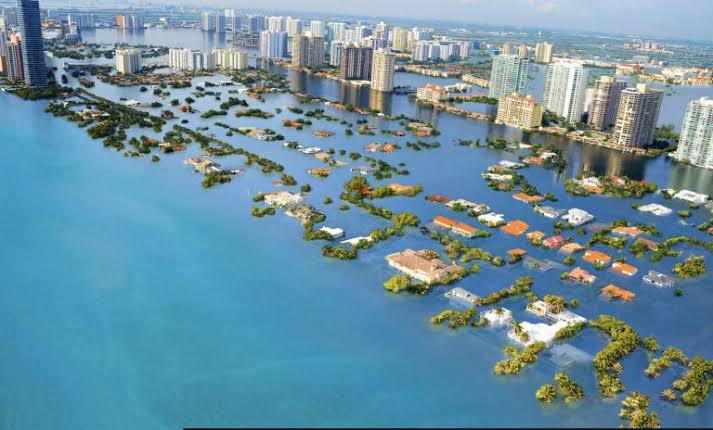
Communities need to adapt to prepare for more climate events to come. Homes, roads, and infrastructure need to be elevated. Drainage systems needs to be hardened. Natural infrastructure—a well-placed park or a mangrove tree—can help keep water out of communities. Some neighborhoods may need to be abandoned altogether.
But there’s a point when adaptation isn’t enough. If temperatures continue to rise on their current trajectory, coastal communities across the Florida could face more than eight inches of sea level rise by 2040 in even a moderate scenario, according to data from Resources for the Future, an energy and environment research group.
That may not sound like a lot, but it will contribute to a nearly 20% chance of annual flooding of three feet. Saltwater would intrude on drinking water supplies. Heat would reduce the productivity of agricultural workers in the places where farming remains viable. It’s easy to imagine entire parts of the state becoming uninhabitable.
In short, a scientifically guided approach to climate change would require both adaptation and mitigation. Some parts of Florida are willing to try. In Miami-Dade County, local officials are working to prepare existing infrastructure for floods, while also pursuing policies to electrify local transport, push buildings to be more energy efficient, and offer boats a low-emissions fuel. “We are part of the impact on the world,” says Daniella Levine Cava, the mayor of Miami-Dade County. “We have to set an example.”
In the scheme of global emissions, the county’s may be close to negligible, but it’s an approach that recognizes the truth of not only Florida’s future but all of our futures on a warming planet. No matter how much we spend, adaptation alone can’t save us.
END Xxxxxxxxxxxxxxxxxxxxxxxxx
Share This Post
