
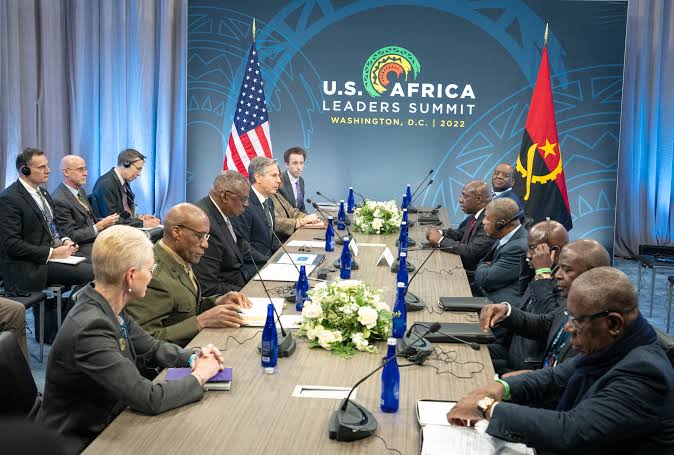
Following the successful completion of the 2022 U.S-Africa Leaders Summit in Washington DC, lawyer and foreign affairs analyst, Henry Ugwu, has noted that in recent years, Africa has become the cynosure of world powers, with people expressing suspicion that the growing interest is reminiscent of the scramble for and partition of Africa, following the Berlin Conference of 1884-1885.
The event, which held between December 13-15 was organised by U.S. President Joe Biden, where African leaders discussed how to boost future Africa-U.S. relations.
Reacting on the Summit, Barr. Ugwu said many observers are worried that the Summit is a strategic plan to draw Africa closer to the U.S., so that America can continue to exact its strong influence on the continent, especially as the influence of China and Russia has grown tremendously.
“Russia, for instance, has significantly increased its political and economic relations with Africa, especially in its sale of Russian military equipment and hardware to many African countries.
“After Vladimir Putin hosted a Russia-Africa Summit in 2019, Russia became Africa’s biggest arms supplier the following year. It is, therefore, not surprising that some African countries have refused to comment or criticise Russia on its invasion of Ukraine.
“China too continues to work strategically to strengthen its hold on the African continent, especially through its huge loans and economic activity. The Forum on China-Africa Cooperation (FOCAC) also exists as a platform to foster China’s interests in Africa. The United Kingdom and France, whose relationship with Africa has deteriorated in recent times, are also involved in various summits with Africa,” Ugwu explained.
He voiced concern that Africa is extremely vulnerable, hence the heightened and competing interests of world powers seeking to exact the strongest influence on the continent.
“Nigeria, as a leader in Africa, should be able to see below the surface and resolve to change the narrative in Africa. We should be able to provide credible leadership in our country and guide the continent away from the traps of many world powers who merely see the continent as a pawn in their power games,” he said.
Ugwu noted that Buhari should, most importantly, pay attention to his nation, which is currently faced with devastating economic policies and security challenges.
According to him, “it would ordinarily have been expected that the President pays attention to Nigeria first. He is travelling with a retinue of aides. And one only wonders the financial implication of these trips at a time when Nigeria is in dire need of firm leadership and austere application of finances.
“The vice president or a minister in the government should be more than sufficient to represent Nigeria at forums like these, especially given the financial situation of the country, and the background of the Summit elucidated above.”
Former Vice Chancellor, Federal University Oye Ekiti (FUOYE), Prof. Kayode Soremekun, said though the Summit will give the U.S. a platform to engage the African continent on relevant issues, it, however, speaks to the texture and tenor of relations with the U.S., which is that of lopsidedness, where there are hegemonic and magisterial profiles.
“This much is evident in the fact that one power, in this case, the U.S., summons some African countries to a meeting. The point to note here is: can a reverse situation happen?”
He said it is important to appreciate the nuances and dynamics of U.S. foreign policy. “In relative terms, Africa is not important in U.S. foreign policy calculations. In terms of priorities U.S. understandably pays attention to places, like Europe, Russia, Latin America and Asia. And then at the bottom of the totem pole is Africa.
“Though it must be said that the U.S. is important to Africa. These depositions also speak partly to the internal dynamics of the U.S. political system. This is a system in which, many blacks continue to be consigned to the margins. The novels of Richard Wright and James Baldwin speak to what I am saying here. Indeed the truism continues to hold for the U.S. or any society, that if you want to understand any society, try to have a grasp of what its novelists are saying, hence my reference to Wright and Baldwin.”
Soremekun noted that some gains could come from the Summit by countries benefiting from programmes, such as Power Africa, The African Growth and Opportunity Act.
He said: “In the context of an overall picture, these are mere cosmetics. For the African continent to be meaningful to itself and the U.S., the leaders must build the continent themselves. The U.S. will not, understandably, do this for them. The U.S. is in the game of foreign policy for the protection of its interests. Africa must take a cue from this and protect its interests.
“A lot depends on Nigeria to lead the charge by ensuring a situation in which Africa becomes more of an actor, rather than a mere arena in international relations.”
On his part, Executive Director, Sterling Law Centre, Deji Ajare, said though the trip to U.S. further solidifies Nigeria’s place and recognition globally, the delegates should focus on increasing foreign investment and a fair energy transition plan.
He said: “The President’s trip is not out of place. If anything at all, the invitation to Nigeria and the fact that the President will be delivering a speech on the first day of the Summit is indicative of the kind of respect Nigeria still commands globally, despite being perennially in the hands of bad leaders.
“Attending the event doesn’t also deviate from Nigeria’s age-long policy of non-alignment. Clearly, Nigeria still maintains good diplomatic relations with the Western bloc, Russia, China and the Middle East.
“I would be more concerned with how the President and his delegation harness the benefits of this Summit to increase foreign investments in Nigeria and canvass for a fairer energy transition plan that ensures Third World countries are compensated for whatever opportunities they are giving up.”
Also, Member, National Institute of Policy and Strategic Studies (NIPSS), Omoba Tunde Ajibulu, said there is a possibility that the U.S. would solicit the help of Africa in the fight against Russia, adding that Buhari’s presence at the event would greatly impact Nigeria positively.
“The Summit will definitely discuss a number of topical issues of global significance. This will include climate challenges, renewable energy, counter terrorism, economic issues, COVID-19 and other pandemics and, of course, the U.S. may solicit Africa’s support in its fight against Russia.
“The presence of Mr. President at the Summit will enable him advance Nigeria’s position and also shape outcomes that would impact Nigeria and Africa.”


